By Nathan Devlin
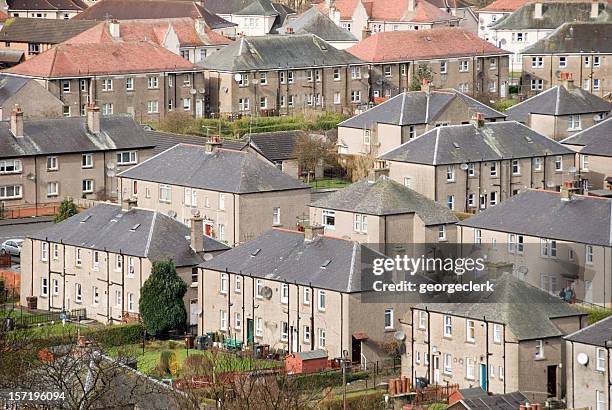
Rough sleeping in Scotland’s cities is becoming more prevalent, with increasing numbers of people sleeping in doorways and on high streets across the country.
Murray Easton, 52- Head of Fundraising for The Simon Community, on how rough sleeping has changed said:
“It's not changed; other than we are seeing more people on the streets. About three or four years ago in Glasgow, for example, we had single figures of people rough sleeping.
“After Covid the numbers were still very low in Glasgow, single figures. Edinburgh is always a little bit higher being the capital city. It was double figures but under 20. Currently in Glasgow, there's about 25 people rough sleeping, in Edinburgh sadly, it's about 80.”
More than 18,000 families are now trapped in temporary accommodation across Scotland as homelessness reaches its highest level in over two decades.
Since the Scottish Housing Crisis was acknowledged by the Scottish Government the cases for homelessness and rough sleeping have only continued to rise. This is despite strong action taken by the Scottish Government. Edinburgh has seen a particular increase over the last 6 years since Covid-19 started.
Jo Laidlaw, 55, freelance journalist, who works mainly in and around Edinburgh has said she has personally seen an increase:
“Maybe in Covid when we didn't go out that much and certainly didn't go up the town that much you wouldn’t see many. Then suddenly you're seeing unhoused people on the street, and it feels like a lot more.”
The Scottish Government first declared the Scottish Housing Crisis on May 15th, 2024. This followed 14 local authorities previously declaring housing emergencies, with the first being in June 2023.
However, it is not the first time the Scottish Government has sought to deal with housing.
Former First Minister Nicola Sturgeon set out a plan in 2018 to build new homes. At a press conference she said:
“The pledge I am making today is to increase capital investment year on year, so that by 2025/26 it is £1.5 billion higher than the 2019/20 baseline of around £5 billion.”
The policy was largely effective, with 41,364 homes being built in that time according to the Scottish Government. However, this fell short of its targeted 50,000. Of those built 28,154 homes became social housing, again falling short of 35,000 targeted.
The Government claims that if the Covid-19 pandemic hadn’t happened they would have met the 50,000 targets. A report published by Audit Scotland in April 2020 praised the SNP Government. They said the Government had made “good progress” in their approach to the target. However, they also saw significant risks and concerns in the government budget after 2021, which they felt could slow progress.
These figures do not reflect or address the housing loss. After taking everything into account Scotland only had a net gain of 25,000 social houses.
Despite this, however, homelessness and rough sleeping numbers have continued to rise. In 2025, the number of families in temporary accommodation was 18,092 a 6% increase, the highest level since 2002.
That same year, there were 20,643 applications for homelessness assistance which was 2% lower than in 2024. However, the number of open cases was 33,006 an increase of 4% and the highest number since 2003.
The chart below from the Scottish Government shows the number of homes started between 2012 and 2025.
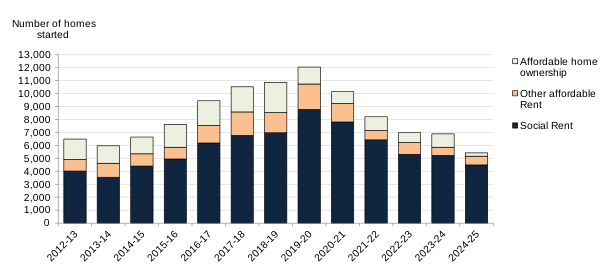
The number of new house completions fell by 11% compared to 2023, while new housing starts dropped by 24%. In 2023, 16,274 homes were started — the lowest figure since 2014. Home completions also fell by 6%, according to the Chartered Institute of Housing.
Despite the increase in social housing in 2025 over 10,000 children in Scotland were living in temporary accommodation. Furthermore, 14,371 children were assessed for homelessness in September of 2025.
The Simon Community Scotland works to support people experiencing homelessness by helping them off the streets and into accommodation. The charity provides mental health, addiction and day-to-day support, including help with shopping and finding employment. It also carries out homelessness and rough sleeping counts in Glasgow and Edinburgh.
Reflecting on this Murray said: “The housing emergency is not going to change. We've got to bring it back to real basics here. We need more affordable housing. How can we fast track making that happen? How can we work with house builders? How can we get that through Government quickly?”
“I think there's potentially some really easy wins for the Government, to come in and say, right, let's sort this out. They've really got to have the genuine desire to sort it out and not worry about politics and votes.”
Jo Laidlaw said: “We should as a nation look at how we house our people from absolute top to absolute bottom. I understand that means we're, going to be looking at things like developers and bringing on commercial businesses and that can be tricky.”
The ‘right to buy’ scheme predates the Scottish Parliament, having first been introduced by the Conservative government in the 1980s. The scheme allowed residents to purchase their homes from the council at a discounted rate for the first time and was largely met with praise in Scotland.
Jo Laidlaw said:
“We collectively as a nation in Scotland and England in the 80’s bought into this belief that the only way to be safely housed was to own a house.”
“Because actually, why not incentivise those landlords to reduce their rent and put that house back into the market?
“None of this is solving the whole scale problem. In the same way as buying a council house was great for that generation.
“My mum bought her council house. That council house would have never gone back on in the market. It would never return to council housing and that doesn't feel right.”
However, this scheme was abolished by the SNP government in July of 2016 by Nicola Sturgeon who at the time called it “One of my best achievements.” In doing so, it protected the country’s social housing stock from sale.
A decade on this scheme is making a return of sorts. Under new proposed legislation should the SNP get re-elected. If an owner of a rental property decides to sell, the renter will get a period of exclusivity to buy the property at a fair market rate.
When making this announcement on April 10th First Minister John Swinney said:
"So many people are stuck paying more on rent than they would on a mortgage - and with costs just going up and up, there is nothing left over at the end of the month to save for a deposit.
"That is made all the more difficult when private renters find themselves having to leave their home because the owner has decided to sell up. As well as forcing people to upend their whole lives, it also has serious financial implications.”
The Scottish Conservatives called this plan “I’ll thought out”. With the Lib Dems and the Greens both accusing the SNP of repeatedly failing to get housing under control during their time in charge.
Reform have previously stated they will make local people on housing lists a priority with the Greens calling for “bolder” action.
Scottish Labour’s housing spokesman Mark Griffin said: “The idea that establishing yet another quango taking more of taxpayers' money - will fundamentally fix this situation is misguided and could represent poor value for money.”
At the start of 2026 according to Registers of Scotland the average price of a house rose to £188,000. In Edinburgh the average price for a house is £294,000 which is £26,000 higher than the UK average of £268,000, increasing concerns that buying a home is becoming unaffordable for some and difficult for first time buyers.
In response, to Scotland’s Housing Crisis the Scottish Government set up the Housing Emergency Action Plan with their main aims being:
Ending children living in unsuitable accommodations – a vital part of the Scottish Government’s determination to eradicate child poverty.
Supporting the housing needs of vulnerable communities; and building our future – maximising investment in Scotland’s housing sector.
The progress is tracked on the Scottish Government website, and is as follows:
Supported around 2700 households with children into affordable housing in the year to December 2024.
Provided £1 million funding for tenancy sustainment projects.
Returned a record-breaking 2066 homes to use via the Scottish Empty Homes Partnership.
Brought almost 1000 homes back into use through £40 million of investment.
Increased the Affordable Housing Supply Programme budget to £768 million for financial year 2025 – 26.
Removed barriers on stalled sites to deliver up to 20,000 homes.
Progressed legislation to improve tenants’ rights and homelessness prevention through the Housing (Scotland) Bill.
Yet despite this the number of cases for homelessness have continued to rise.
In the Housing Emergency plan, the first step the Scottish Government identified is ending children living in unsuitable accommodations. Their main way of combatting this is to pledge from £40 to £80 million this financial year with the focus being on acquiring housing. They will also work together with councils to ‘flip’ temporary accommodation into permanent housing, providing social housing for those who need it, in an attempt to reduce the social housing list and meet demand.
Reform has a three-point plan to end homelessness should it be elected to Holyrood on May 7th. That involves 1) Bringing in legislation that prioritises Scottish people on housing lists, closing the SNP migrants’ gaps that saw illegal migrants being prioritised over Scottish families. 2) They would then lobby the UK Government to remove Glasgow’s ‘dispersal city’ status and review their powers on removing illegal migrants from Scottish towns and cities to home office sites. 3) They would introduce legislation that would charge international students council tax and put that money into new social housing.
The Scottish Greens want to end homelessness by the end of the year 2040. To do this they would build an estimated 15,700 homes every year until the year 2031.
However, the Greens plan doesn’t consider the current back log in housing. Some in the construction sector have called this plan ‘ambitious’. Others feel this is partly a consequence of a protracted planning process, meaning that planning could take longer than expected. They are also proposing councils force owners of un-used land to sell to the Greens. To block the construction of student accommodation, in favour of long-term housing. Councils will also be granted the powers of blocking developers "with a track record of building sub-standard homes".
The Scottish Greens say the 2040 pledge if elected would be a "statutory target" that would define future legislation.
Reflecting on what he would like to see from the next government Murray said:
“This needs a really big debate, and the Government needs to sit down and talk to the likes of us and other charities to get a sense of what needs to be done.”
“If you go on the Scottish Government website and you look at the official homelessness figures, it's 40,000 people. There are 30,000 open cases just now for homelessness.”
Jo said:
“I would like to see a massive review that considers people's opinions and how they feel. That shouldn’t be party politicised. It should be led by somebody really independent. There also should be a root and branch review of housing policy to create a housing policy that is interlinked.
“But no council's got any money apparently for anything. Why do councils not really have the power to buy back housing?”
The Scottish housing crisis is ever evolving. By the time this article goes to print, something else will have changed. The upcoming Scottish Parliament election takes place on May 7th,
and a new government will have been elected. No matter how the election goes, whoever gets the keys to Holyrood, one of the first issues they will need to address is the Scottish housing crisis. Holyrood will face growing pressure to address an issue likely to remain a major challenge for Scotland’s government, society and economy for years to come.
Add comment
Comments